
The Federal Government has said it is working towards developing a balanced national port system where Lagos and the Eastern ports complement one another in handling Nigeria’s maritime traffic. Government
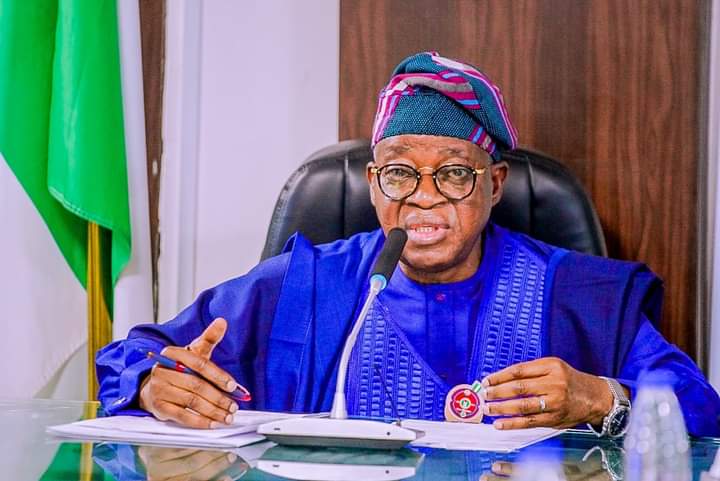
The Minister of Marine and Blue Economy, Adegboyega Oyetola, stated this yesterday in Lagos at the Annual General Meeting and Conference of the League of Maritime Editors.
Oyetola, who was represented by the ministry’s Director of Press, Mrs Anastasia Ogbonna, said the concentration of cargo and vessel calls at Lagos ports, while Eastern ports remain underutilised, was no longer sustainable.
Speaking on the theme: “Lagos / Eastern Ports: How to Reverse Existing Imbalance in Disproportionate Cargo Vessel Calls,” the minister said the imbalance had implications for national logistics costs, regional economic development, infrastructure utilisation, investment and the competitiveness of Nigeria’s maritime sector.
According to him, Lagos ports, particularly Apapa and Tin Can Island, have historically handled the bulk of the country’s seaborne cargo because of their importance and the concentration of commercial activities in Lagos. City& Local Guides
He, however, said the resulting pressure had led to congestion, longer cargo dwell and vessel turnaround times, increased demurrage and logistics costs, pressure on road infrastructure and other inefficiencies across the supply chain.
Oyetola said the Eastern ports, including Onne, Port Harcourt, Warri and Calabar, had considerable strategic and economic potential that could be harnessed to serve the South-East, South-South and parts of the North-Central. Politics
He said their proximity to major industrial, agricultural, energy and commercial activities gave them a natural advantage in handling cargo for large portions of the country’s hinterland.
The minister noted that the ports could support regional industrial clusters, facilitate exports, promote agro-allied value chains and stimulate economic activities across the Eastern and Niger Delta regions.
He, however, identified draft limitations, infrastructure deficiencies, navigational constraints, security concerns, poor hinterland connectivity, inadequate equipment, operational costs and unpredictable services as some of the factors affecting the ability of the Eastern ports to attract regular vessel calls.
Oyetola described the need to reverse the imbalance as a national economic imperative rather than a regional demand.
He said the Federal Government, under President Bola Ahmed Tinubu’s Renewed Hope Agenda, had adopted a strategic approach to transforming Nigeria’s maritime infrastructure and making the sector a stronger driver of economic growth.
He said the Ministry of Marine and Blue Economy and its agencies were committed to developing an efficient and interconnected port system in which Lagos and the Eastern ports would complement each other. Economics
“Modernisation and rehabilitation of the Eastern ports are integral parts of the Federal Government’s port development strategy,” he said.
According to him, government’s plans include improving channel depths and navigability, rehabilitating critical port infrastructure, enhancing navigational safety, upgrading cargo-handling facilities and strengthening security.
He also cited the reconstruction of breakwaters and channel-management interventions, including works along the Escravos Channel, as part of efforts to improve the nation’s maritime infrastructure.
The minister said government was encouraging greater private-sector participation in port development, noting that the scale of investment required could not be borne by government alone. Government
He said the objective was to make every viable Nigerian port capable of competing for cargo on the basis of efficiency, reliability, cost and quality of service.
Oyetola also addressed concerns over the Federal Government’s current focus on major physical modernisation activities at the Western ports, particularly Apapa and Tin Can Island.
He said the attention given to Lagos was not based on preferential treatment but on “operational urgency, economic necessity, project readiness and responsible sequencing.”
According to him, Lagos remains Nigeria’s principal maritime gateway and handles the largest concentration of import and export cargo.
He said addressing congestion and infrastructure constraints at the busiest ports would provide the quickest opportunity to reduce systemic inefficiencies and deliver immediate economic benefits.
Oyetola said carrying out major reconstruction simultaneously across the Western and Eastern gateways without adequate alternative capacity could disrupt cargo movement and expose the national supply chain to unnecessary risks.
He explained that the Lagos port modernisation programme attained financial and contractual readiness earlier, enabling implementation to begin ahead of some interventions in the Eastern ports.
He stressed that the sequencing should not be interpreted as neglect of the Eastern ports.
“The long-term objective of the government is not simply to improve the Lagos ports. Our objective is to create a multi-port system in which cargo owners and shipping lines have viable alternatives,” he said. Government
The minister added: “We are not developing Lagos at the expense of the East. We are strengthening Lagos while building the capacity of the Eastern corridor to assume a greater and more strategic share of national maritime traffic.”
He said improved infrastructure alone would not automatically lead to the redistribution of cargo and vessel calls, noting that shipping lines consider factors including draft, berth
Follow the OSUNDOTLIFE channel on WhatsAppKindly share this story | All rights reserved. This material, and other digital content on this website, may not be reproduced, published, broadcast, rewritten or redistributed in whole or in part without prior express written permission from OSUNDOTLIFE.
Contact: editor@osun.life
WhatsApp: 📲 +2348092333666