
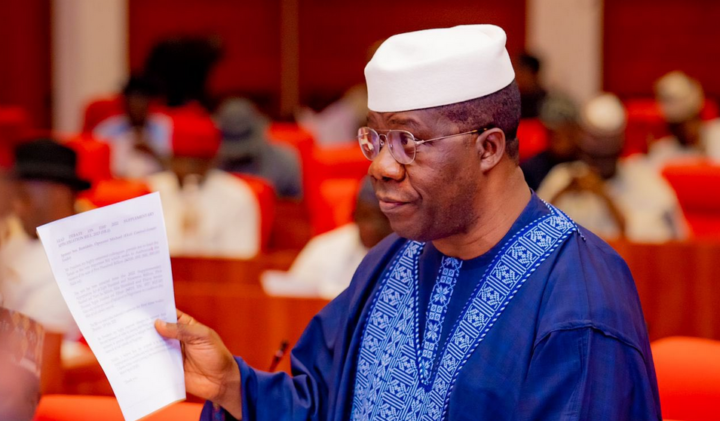
The Leader of the Senate, Senator Opeyemi Bamidele, has dismissed concerns that the newly enacted tax laws were designed to inflict economic hardship on Nigerians.
He insisted that the legislation is a people-centred intervention aimed at strengthening the country’s fiscal base and improving living standards.
Bamidele made the clarification in a statement issued in Abuja on Wednesday, amid growing public debate and criticism from the opposition over the implementation of the new tax regime.
He maintained that the intent of the law has been grossly misrepresented in public discourse.
“The new tax law was not initiated to inflict economic hardship on ordinary people, as being misconstrued in the public space,” he said.
According to him, the Senate and the National Assembly as a whole worked closely with other arms of government in driving the reforms, while preserving their constitutionally guaranteed independence.
“The Senate, indeed the National Assembly, has collaborated with other arms of government to effect the reforms without any prejudice to our constitutionally guaranteed independence,” he said.
He noted that the legislature recorded significant milestones in the 2025 financial year, including the enactment of a new tax regime, the elimination of multiple budgets, constitutional review efforts, and reforms to recalibrate the country’s electoral system.
“In the 2025 financial year, we have achieved quite a lot in enacting a new tax regime; ending the culture of multiple budgets; working with key stakeholders to review the 1999 Constitution and recalibrating our electoral regime to be more credible and transparent,” he explained.
Bamidele described the 2025 Tax Reforms Act as the most consequential of the reforms, explaining that its primary objective is to harmonise Nigeria’s tax system and eliminate multiple taxation from January 1, 2026.
“The enactment of the 2025 Tax Reforms Act, for instance, is perhaps the most consequential of all these reforms. Its core intention is to introduce a cohesive tax regime that will, from January 1, 2026, end the era of multiple taxation and ensure improved life for the citizenry, especially for those at the lowest rung of our national economy,” he added.
He stressed that the law was passed after extensive consultations with stakeholders across business, political and social sectors, contrary to claims by critics.
“The Act, duly enacted after multi-levelled consultation with stakeholders across business, political and social interests, does not represent the gloomy picture the opposition forces are painting,” Bamidele said.
Rather, he said the reforms are structured to address long-standing fiscal and liquidity challenges that have hampered national development.
The Senate leader urged Nigerians to study the provisions of the Tax Reforms Act and avoid being swayed by misinformation, particularly as aspects of the new tax obligations take effect.
“Rather than take a mere cursory look at its details, Nigerians across all socio-economic strata have the duty to study the Tax Reforms Act and be adequately informed about what they intend to achieve, more importantly, as Nigeria aspires to catch up with the rest of the world in modern tax administration,” he stated.
Bamidele also reaffirmed the Senate’s support for the administration’s policy direction, while rejecting claims that the legislature merely rubber-stamps executive decisions.
He said, “For us at the National Assembly, we again reaffirm our commitment to nation-building and unalloyed support for the people-centred initiatives driven by the ‘Renewed Hope Agenda’ of President Bola Tinubu.
“Away from the rubber stamp narrative, in 2026 and beyond, the Senate will not shirk its responsibilities of guiding and offering necessary advice to other arms of government in line with the principle of checks and balances, and in the overall interest of our nation and its people.”
According to him, the reforms are designed to expand government revenue at all levels to fund infrastructure and long-term economic growth.
Recalling the legislative process, Bamidele said the passage of the tax reform bills followed months of rigorous scrutiny.
“Rather, it aims to bring more resources to the footsteps of the government at various levels for the delivery of more strategic infrastructure that will translate to economic prosperity for generations to come.
“Nigerians will recall how it took the current National Assembly several months of painstaking scrutiny and late-night meetings before the eventual passage of the proposed tax reform bills,” he noted.
The senator added that the process strikes a balance between protecting ordinary Nigerians and the need to modernise the country’s tax administration.
Bamidele urged Nigerians to resist what he described as deliberate misinformation by the opposition.
“Rather than falling hook, line and sinker for the deliberate misinformation being peddled about the new reforms by the opposition, I urge every Nigerian to get adequately informed about their ambitious goals and advantages for our collective good, aiming to take more from the rich to cater for the poor in our midst,” he urged.
Meanwhile, President Bola Tinubu has reaffirmed that the implementation of the new tax laws, including those enacted on June 26, 2025, and others scheduled to commence on January 1, 2026, would proceed as planned.
The President said the reforms represent “a once-in-a-generation opportunity to build a fair, competitive, and robust fiscal foundation” for Nigeria, stressing that the laws are not intended to raise taxes but to drive a structural reset, promote harmonisation and protect human dignity while strengthening the social contract.
Tinubu urged stakeholders to support the implementation phase, which he said is now “firmly in the delivery stage,” adding that no substantial issue has been identified to justify halting or disrupting the reform process.
Follow the OSUNDOTLIFE channel on WhatsAppKindly share this story | All rights reserved. This material, and other digital content on this website, may not be reproduced, published, broadcast, rewritten or redistributed in whole or in part without prior express written permission from OSUNDOTLIFE.
Contact: editor@osun.life
WhatsApp: 📲 +2348092333666